
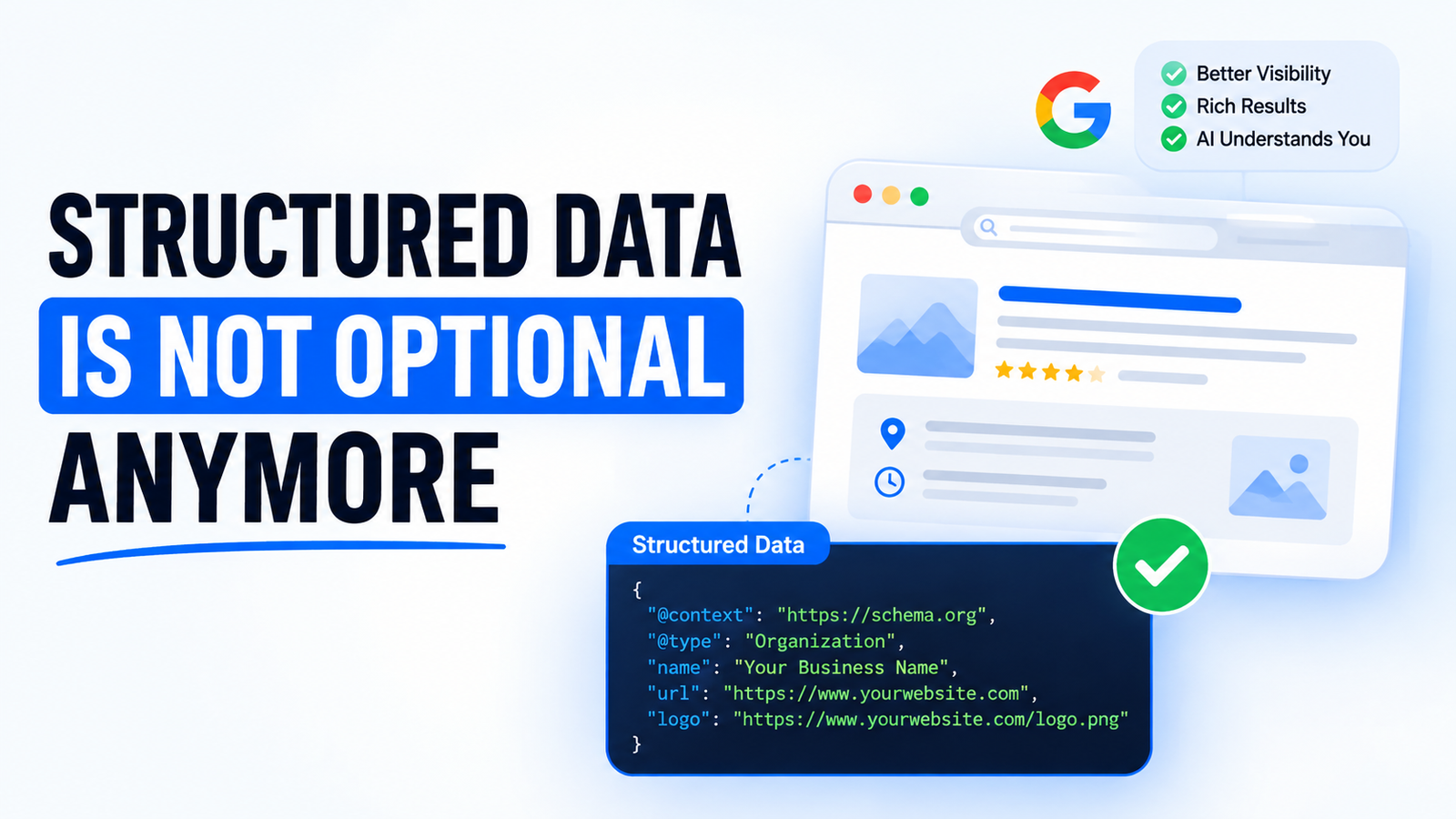
Schema in 2026: Structured Data Is Not Optional Anymore: A Local Business Owner’s Guide
Structured Data Is Not Optional Anymore: A Local Business Owner’s Guide to Schema in 2026 If you run a business and a member of your marketing team has referred to ‘schema ‘, you most likely agreed without really knowing what it meant. You’re not the only one; schema is one of those SEO subjects which people discuss a great deal but which seldom have simple explanations that actually make sense in the context of your business. In a nutshell, schema refers to structured data that you include in the code of your website to inform search engines about what your content is about; for example, your business name, address, hours, reviews, service area and so on. This information is not visible to people who visit your site; it simply remains in the background to help search engines understand what your page contains. In 2026, since search results are determined by AI and given that entity-based understanding is required, having a schema is no longer optional; it is a necessity, just as having a friendly website or a fast load time is. I carried out an audit of the schema on various local business websites, including my own. The following is what I found: schema is not a technical matter but rather a way of ensuring that search engines understand what your business is and what it does. Why Schema Matters More in 2026 Than It Did a Year Ago A number of years ago, schema was merely a checkbox for SEO, but nowadays search engines use AI to work out what your business is and what it does; if a search engine cannot clearly determine what your business is, where it operates and what it offers, then it is less likely to display your business in the search results. That is the reason why I regard schema as a means of ensuring that search engines have information regarding your business; you are not attempting to trick an algorithm, you are simply making sure that search engines understand what your business is. The Moment Schema Actually Clicked for Me I only completely realised the value of schema in 2026 when I saw it in use on my site. Once I had added the schema data and checked that it was valid, I noticed that the search results had changed; they were now more informative and stood out. It was at that moment that I realised that a schema is not a trick but a method of connecting what my website states with what search engines understand. What Schema Actually Does (and Does Not Do) Schema markup enables search engines to understand the type of business you have, your business details and the way in which your content is organised. It’s similar to giving a thoughtful assistant a neat and clearly labelled folder rather than a disordered pile of papers. It doesn’t remedy existing problems; the schema in 2026 won’t make up for poor content, inconsistent business details, or negative reviews. It won’t automatically boost your position in search results and cannot guarantee a rich result. The Core Schema Types for Local Businesses For business websites, you don’t need dozens of schema types—just the ones that are implemented accurately. The basic collection comprises: * Organization: establishes your brand as an entity that Google can recognize * LocalBusiness: communicates your business type, location, hours and local-search signals * Person: connects an individual like a founder or consultant to the brand * Website: this term refers to the entire site. It has the capability of enabling a sitelinks search box. * WebPage: describes pages and their role on the site * BreadcrumbList: shows content hierarchy and navigation path * FAQPage: only when a page genuinely contains a clear question-and-answer format All of these types of schema have different roles but function most effectively when used together. JSON-LD vs Microdata: Which One to Use I put the schema into JSON-LD since this is usually the better option for SEO; it separates the data from your HTML, which makes maintenance and updates easier. A Mistake I See Often During Audits A problem that I notice is schema in 2026 that is technically there but in fact incorrect. A business might have LocalBusiness schema, even though the information is out of date or inaccurate. Another error is including FAQ or review markup on pages for which it is not appropriate. The takeaway is that you shouldn’t include schema in 2026 merely because you want to have schema in 2026; each property should be describing something that is actually true and observable on the page. A Simple Framework to Start With If your local business does not already have schema in 2026, don’t attempt to include all the details at this stage. Here is a simple plan: * Make sure your business information is consistent across your website and Google Business Profile Begin with the different types of schema in 2026 and implement them accurately. * Check your schema periodically to make sure it is up-, to-date and accurate All other elements are based on this one. It is necessary to carry this out before you begin to code anything. Include the schema on your website and use JSON-LD format for LocalBusiness, Organisation, WebSite, WebPage and BreadcrumbList. If your business is a specific type, for example a restaurant or a dental office, then use that type rather than the general one. The more accurate and correct the type is, the better it will work. Make sure to check and continue to monitor it. You can use the Google Rich Results Test to verify that your setup looks correct in Search Console by looking for any errors in the data; keep monitoring it over time. Do not expect your rankings to improve immediately and do not become concerned if no changes are visible right away. Structured data is a method for improving clarity in the long term, not a solution. To sum up: first the accurate details, then
Read More