

Why An Authentic Content Marketing Strategy In 2026 Beats Polish In The Age Of AI
Why An Authentic Content Marketing Strategy In 2026 Beats Polish In The Age Of AI
I have been using LinkedIn and Instagram a lot lately. Most posts look the same to me. They have pictures and confident captions. They do not really say anything. This is a problem that an authentic content marketing strategy is trying to solve.
I noticed this when I was building my marketing portfolio, and it’s exactly what shaped my approach to an Authentic Content Marketing Strategy In 2026. The posts that did well were not the ones that looked professional. They were the most transparent ones — proof that an Authentic Content Marketing Strategy In 2026 rewards honesty over polish. Of the posting tips I started sharing, what I was actually learning about were topics like GEO, AEO, and AI search, all filtered through the lens of an Authentic Content Marketing Strategy In 2026.
I shared my thought process, my reasoning, and what I learned from creating the content, because that’s the core of any real Authentic Content Marketing Strategy In 2026. Those posts did well. People actually talked to me about them, which told me an Authentic Content Marketing Strategy In 2026 isn’t optional anymore — it’s the differentiator.
That taught me something: people don’t follow experts. They follow people who show how they think. This isn’t about style. It’s about what earns attention and trust, and it’s the foundation of any Authentic Content Marketing Strategy In 2026 worth building. That shift is happening right when AI tools are making it easier than ever to churn out content, which is exactly why an Authentic Content Marketing Strategy In 2026 matters more than ever. Every brand chasing relevance needs an Authentic Content Marketing Strategy In 2026 — not a louder one, a more honest one. In the end, an Authentic Content Marketing Strategy In 2026 wins because it can’t be mass-produced.
The Polish Trap: When Content Looks Good. Says Nothing
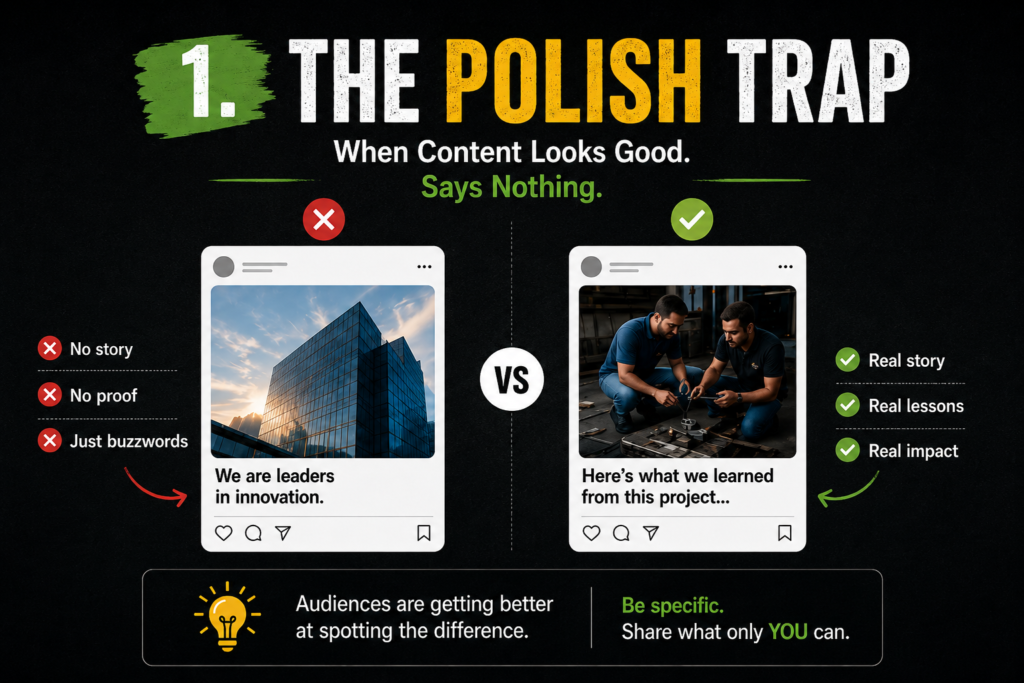
I see a pattern where a company posts something that looks professional. It does not really say anything. It might have pictures and buzzwords. There is no story behind it. No customer example, no lesson learned, no evidence to back up the claim. This comes across as fake. Audiences are getting better at spotting the difference.
Try this test: strip the logo off a post. Can you still tell which company wrote it? If not, it’s probably for show, not substance. Real authenticity is specific. Specific enough that it could only have come from you.
This matters now that AI tools can produce content in seconds. When it becomes easy to make things look good, it stops being something that sets you apart. What is left is substance. That is what AI cannot manufacture: experience, evidence, and a genuine point of view.
A Simple Filter For Authentic Content
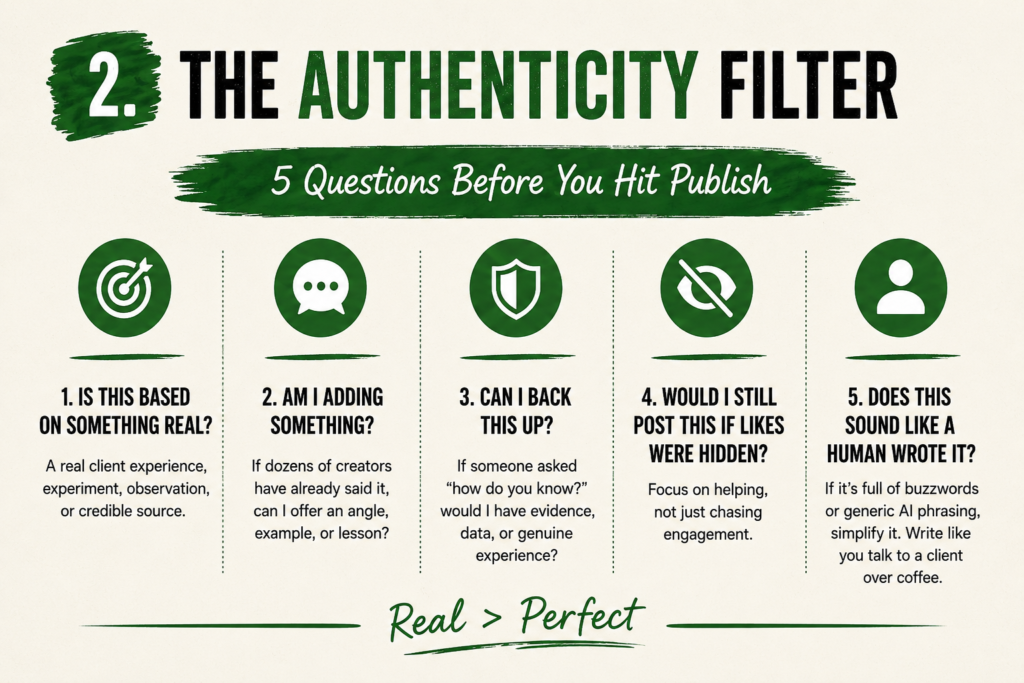
I have developed a checklist that I use before publishing any content. It is not complicated. It has caught a lot of content before it went live:
- Is this based on something? A real client experience, experiment, observation, or credible source. Not something trending.
- Am I adding something? If dozens of creators have already said the thing, can I offer an angle, example, or lesson?
- Can I back this up? If someone asked “how do you know?” would I have evidence, data, or genuine experience to point to?
- Would I still post this if likes were hidden? This filters out content made to chase engagement versus content made to help.
- Does this sound like a human wrote it? If it is full of buzzwords or generic AI phrasing, simplify it. Write the way you would explain it to a client over coffee.
What Happens When Businesses Make The Shift
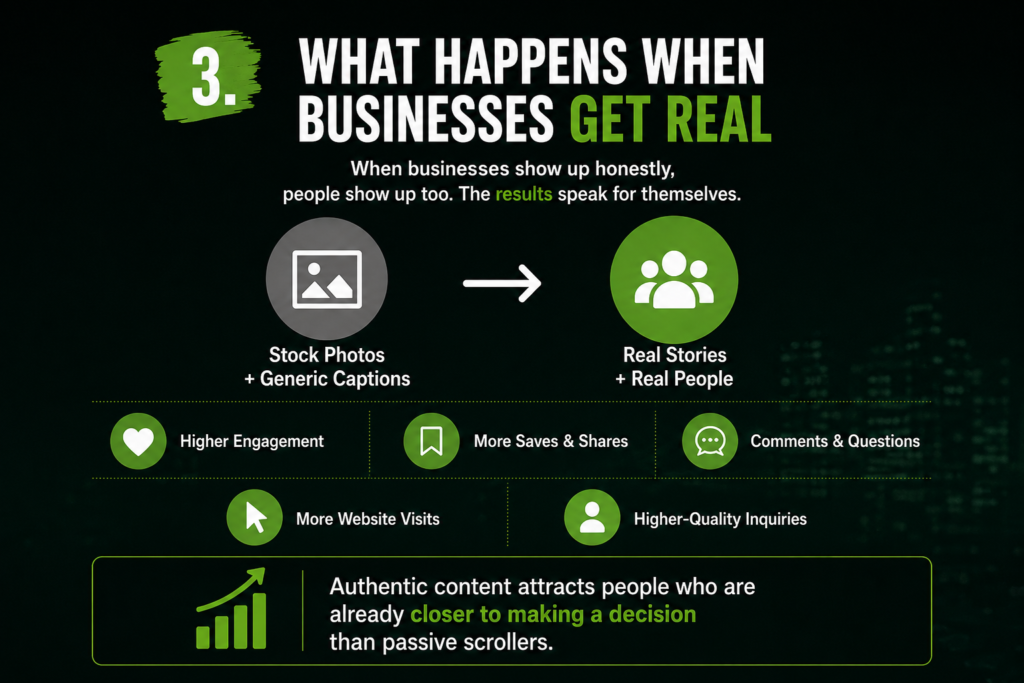
This is not about branding; it is about what happens when businesses make the shift to content. A local service business might move away from stock graphics and generic captions. Start posting project photos, introducing team members, answering customer questions, and sharing genuine testimonials.
The results vary. The direction is consistent: engagement, saves, shares, comments with questions, website visits, and higher-quality inquiries. Authentic content tends to attract people who’re already closer to a buying decision than passive scrollers.
Will Authenticity Matter More As AI Content Grows?
My honest take is yes. Not because audiences are going to reject AI-generated content. It is because AI is making content to produce. When everyone can generate a post in seconds, “well-written” stops being impressive. It becomes the baseline.
What can’t be mass-produced is experience. A lesson, an opinion actually shaped by doing the work. That’s where brand trust in the age of AI content gets won or lost. Not production quality. Whether there’s a person behind the words backing them up with real evidence.
FAQ
Is Content The Same As Unpolished Content?
No, authenticity is about substance and honesty, not sloppiness. You can be well-designed and authentic at the same time.
Can AI-Assisted Content Still Be Authentic?
Yes, as long as the ideas, experience, and point of view originate from a person. AI can help with structure or editing. The substance has to come from expertise or experience.
How Do I Know If My Content Is Too Generic?
Run it through a test: could a competitor post the same thing word-for-word? If yes, it is probably too generic. It needs an example, opinion, or piece of evidence.
Does Authenticity Mean Sharing Everything, Including Failures?
Not everything. Being willing to mention limitations, mixed results, or lessons learned tends to build trust more than a highlight reel.
Is This Approach For Personal Brands? Does It Work For Companies Too?
An authentic content marketing strategy is what beats polish in the age of AI. An authentic content marketing strategy is about being honest and transparent. It is what people are looking for. An authentic content marketing strategy is not about branding; it is about what happens when businesses make the shift to content.
It works for both, though it looks different. A solo creator can share their experience directly. A larger company can do the same by featuring employees, real customer stories, and real behind-the-scenes decisions of anonymous corporate messaging.
Build Content People Trust
A real content marketing strategy is not about abandoning polish. It is about making sure there is something underneath it. As AI makes produced content the default, the businesses and creators who stand out will be the ones to show their actual thinking, admit what they do not know, and back up their claims with experience.
Actionable takeaways:
- Run every post through the five-question authenticity filter before publishing.
- Replace claims with one example.
- When using AI tools, keep the ideas. Experience yours. Use AI for structure, not substance.
- Audit your last 10 posts: how many could a competitor have posted word-for-word?
This strategy is about being real. It is what will make content marketing work for the content creators and the businesses. People will trust the content when it is real. An authentic content marketing strategy is the key to success in the age of AI.Start with your last 10 posts. Audit them honestly. Then decide: are you optimizing for how content looks, or for why an authentic content marketing strategy beats polish in the age of AI in 2026?
Conclusion
An Authentic Content Marketing Strategy In 2026 beats polish because substance is the one thing AI still can’t fake. As more brands lean on AI tools to churn out captions, graphics, and “expert” takes, the businesses that pull ahead will be the ones building a real Authentic Content Marketing Strategy In 2026 — not with better production value, but with real experience, real evidence, and a real point of view behind every post.
The five-question filter isn’t a one-time exercise. It’s a habit, and it’s the backbone of any Authentic Content Marketing Strategy In 2026 that actually works. Run every post through it before you hit publish, and you’ll naturally build the kind of content that reflects an Authentic Content Marketing Strategy In 2026: it’s specific, it’s honest about limitations, and it could only have come from you.
Polish will always matter to some degree — nobody’s arguing for sloppy design or careless writing. But polish alone is table stakes now. Any Authentic Content Marketing Strategy In 2026 has to go further, because trust is built on what’s underneath the design, not the design itself. That’s the whole premise of an Authentic Content Marketing Strategy In 2026 — showing your work, not just your output.
Start with your last 10 posts. Audit them honestly. Then decide: are you optimizing for how content looks, or are you committing to an Authentic Content Marketing Strategy In 2026 that people can actually trust? Because in the end, an Authentic Content Marketing Strategy In 2026 isn’t a tactic — it’s the only strategy that survives contact with AI-generated sameness.
